
the line up
We like it when things stick together.
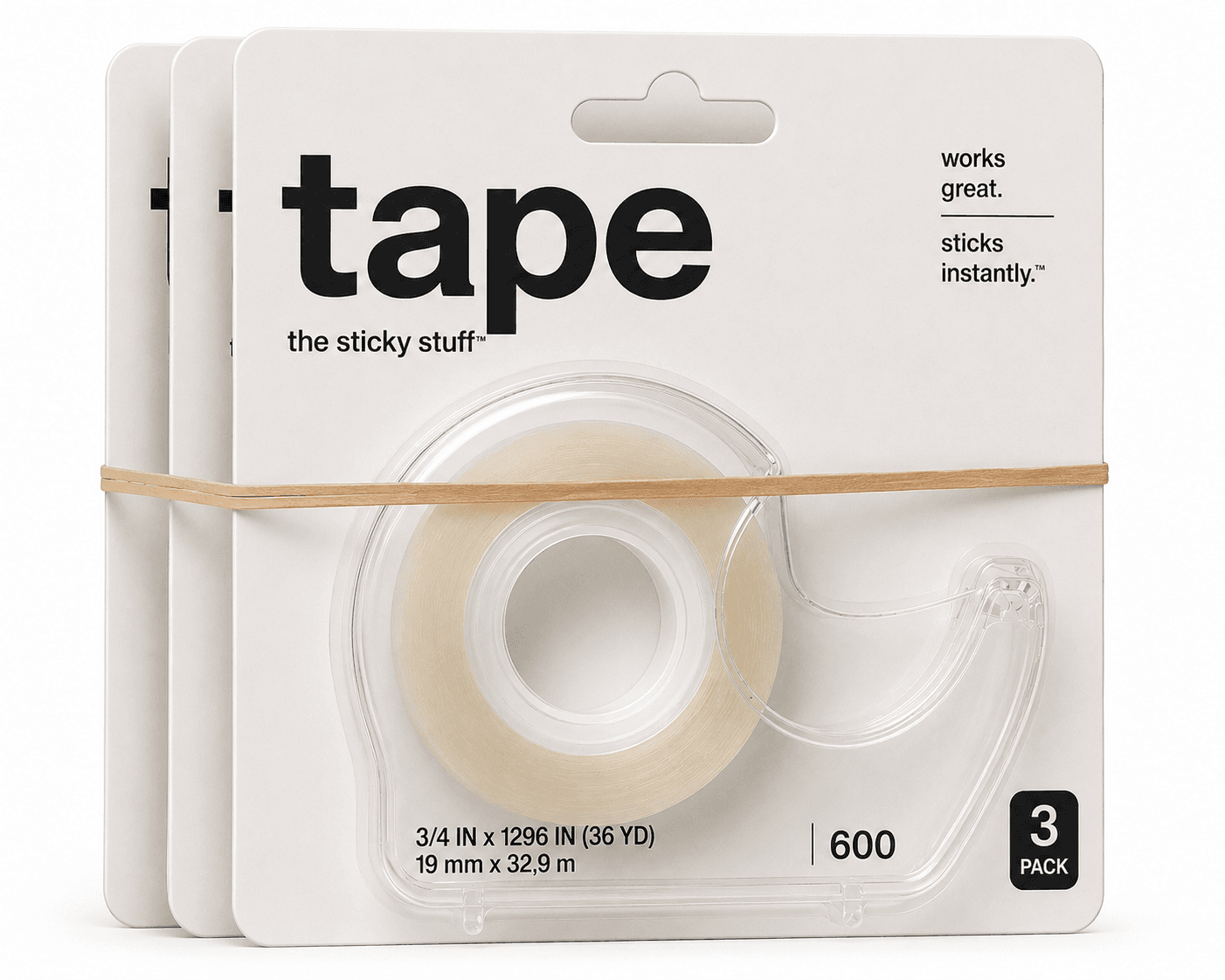
3 pack of tape.
3/4 in × 36 yd per roll. works great. sticks instantly.™
This is good tape. We're not going to tell you it changed our lives. It's tape. It held things together. That's what we needed it to do.
Three rolls. Because one is not enough and four is too many and we thought about it a lot.
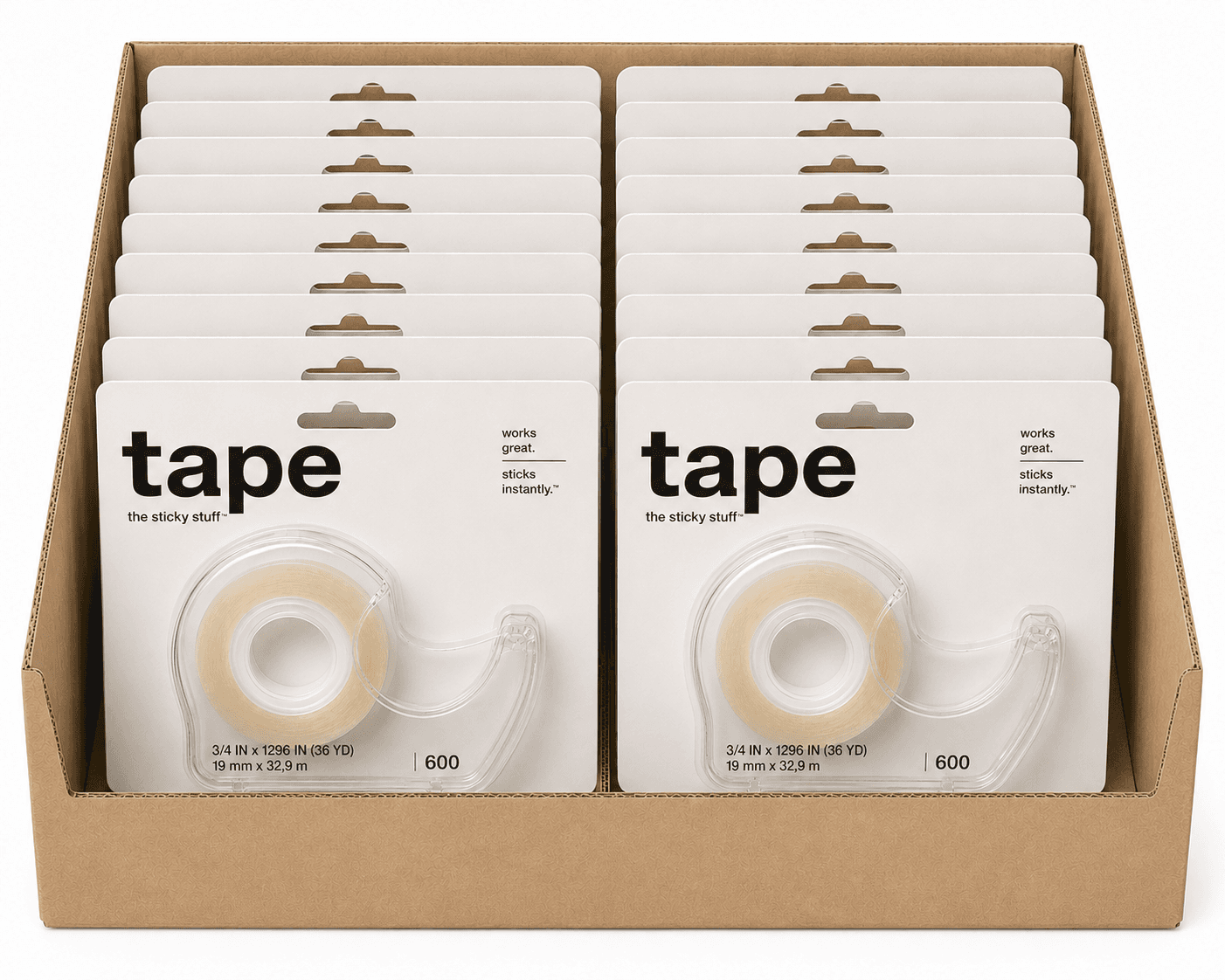
case of tape.
24 rolls and dispensers. for people who go through tape.
You go through tape. You're not embarrassed about it. You shouldn't be. Tape is useful and you use it. Good for you, honestly.
Free shipping. We respect you.
free shipping
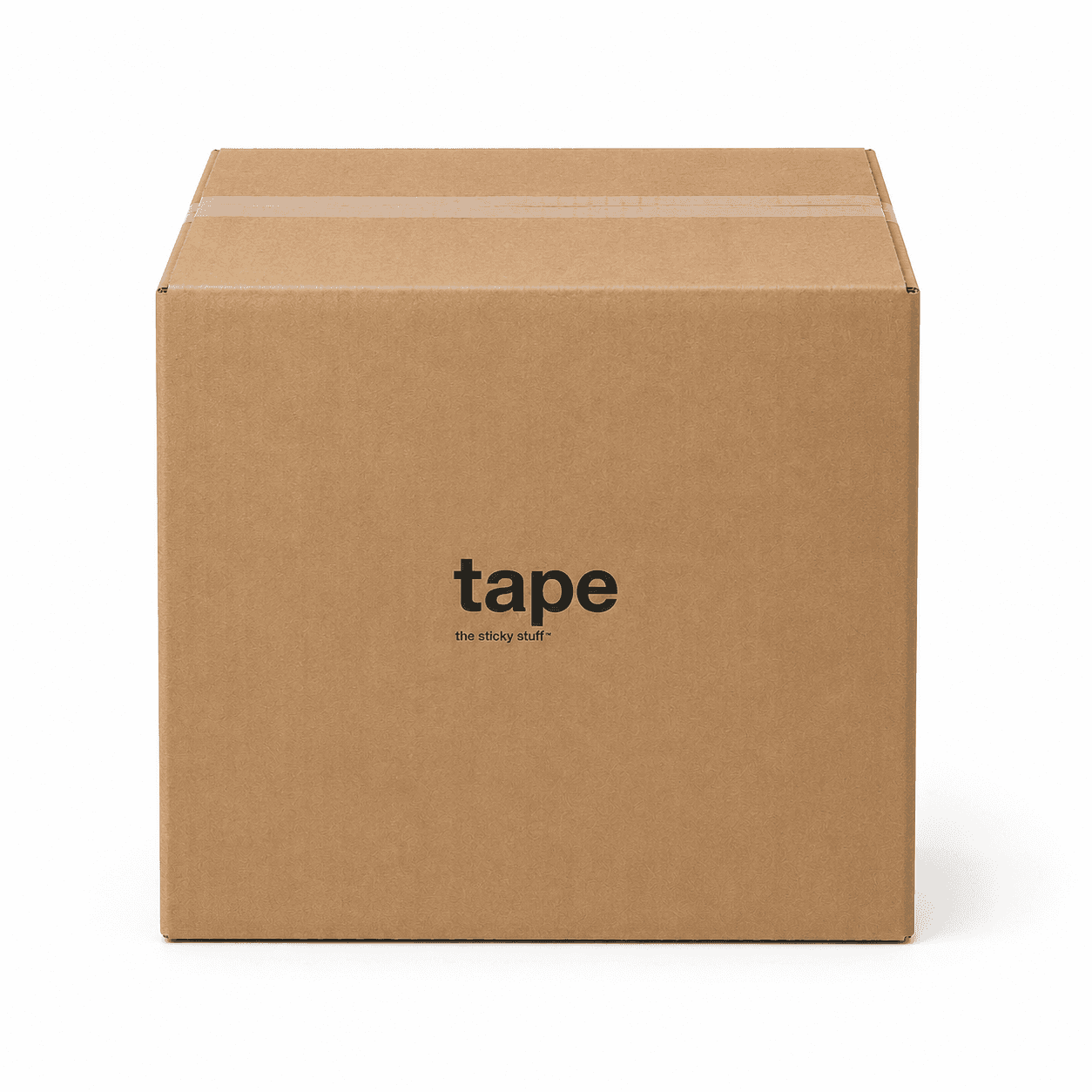
big case of tape.
48 rolls. we respect you enormously.
You've been through a lot of tape. You know what you want. You want tape, and you want a lot of it, and you don't want to think about it again for a while.
This is 48 rolls. That's two cases' worth. We put them in one box so you only have to deal with it once.
free shipping
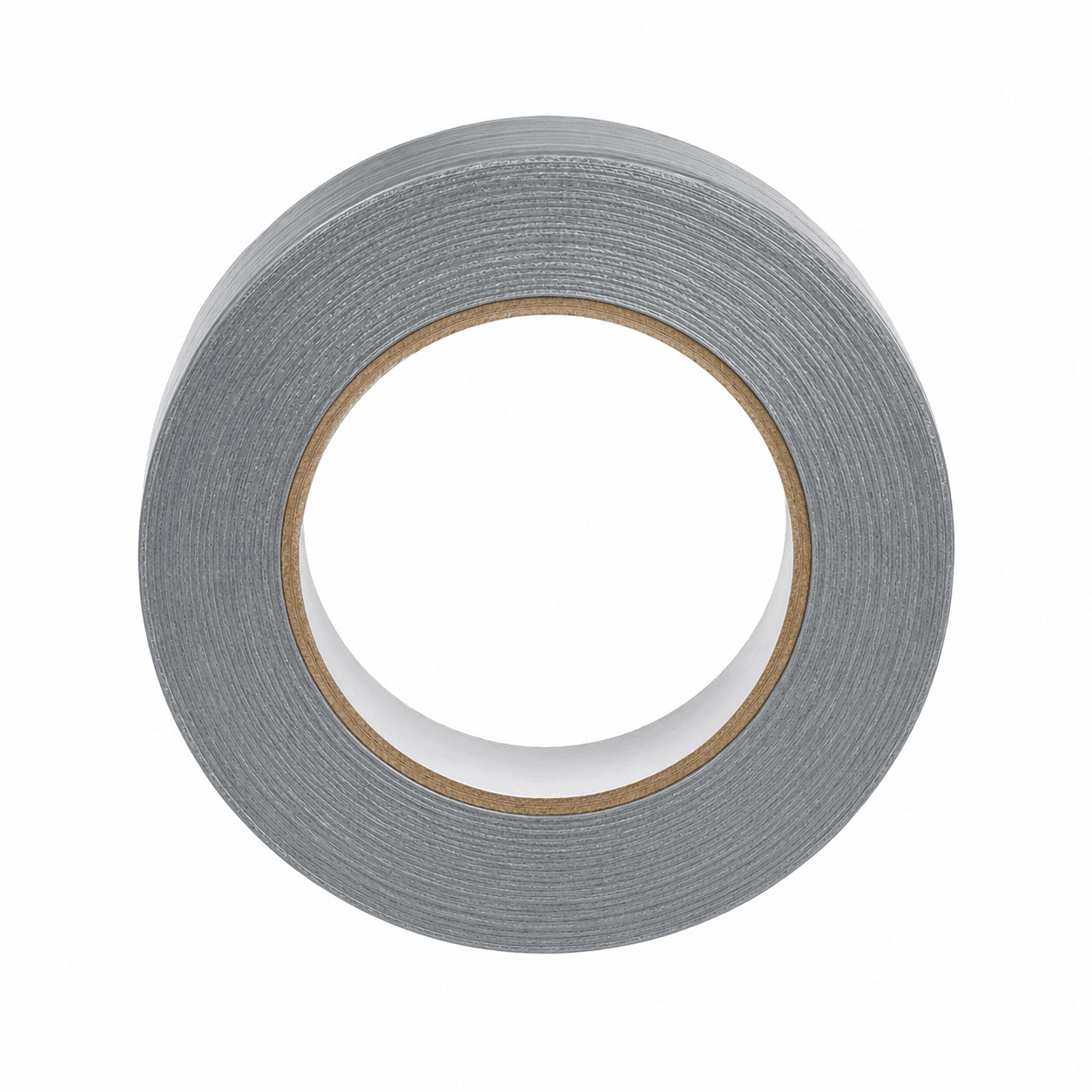
duct tape.
2 in × 35 yd per roll. fixes everything. that's not a joke.
Duct tape has been holding things together since World War II. It has fixed more problems than most people you know. It doesn't ask for recognition. It just works.
This is good duct tape. Silver. Cloth-backed. Tears by hand because it respects your time.
Use it on the thing that needs duct tape. You know the thing.

masking tape.
masking tape. 1 roll. 1 in × 30 yd.
Masking tape is patient. It goes somewhere, holds for a while, and leaves without making a scene. No residue. No drama. No complicated goodbye.
Painters use it. Crafters use it. People who label things in their refrigerator use it and they're doing the right thing.
This is good masking tape. Crepe paper. Clean removal. Writes on it.
crepe paper backing. clean removal. writes on it. very patient.

packing tape.
packing tape. 1 roll. 2 in × 55 yd.
You're sending something somewhere. You'd like it to stay closed. That's a reasonable thing to want.
Packing tape is not glamorous. It is not trying to be. It seals boxes. It does this reliably and without complaint, which is more than can be said for most things.
This is clear packing tape. Heavy duty. Won't yellow. Won't give up halfway through the box.
clear. heavy duty. acrylic adhesive. won't yellow. won't quit.
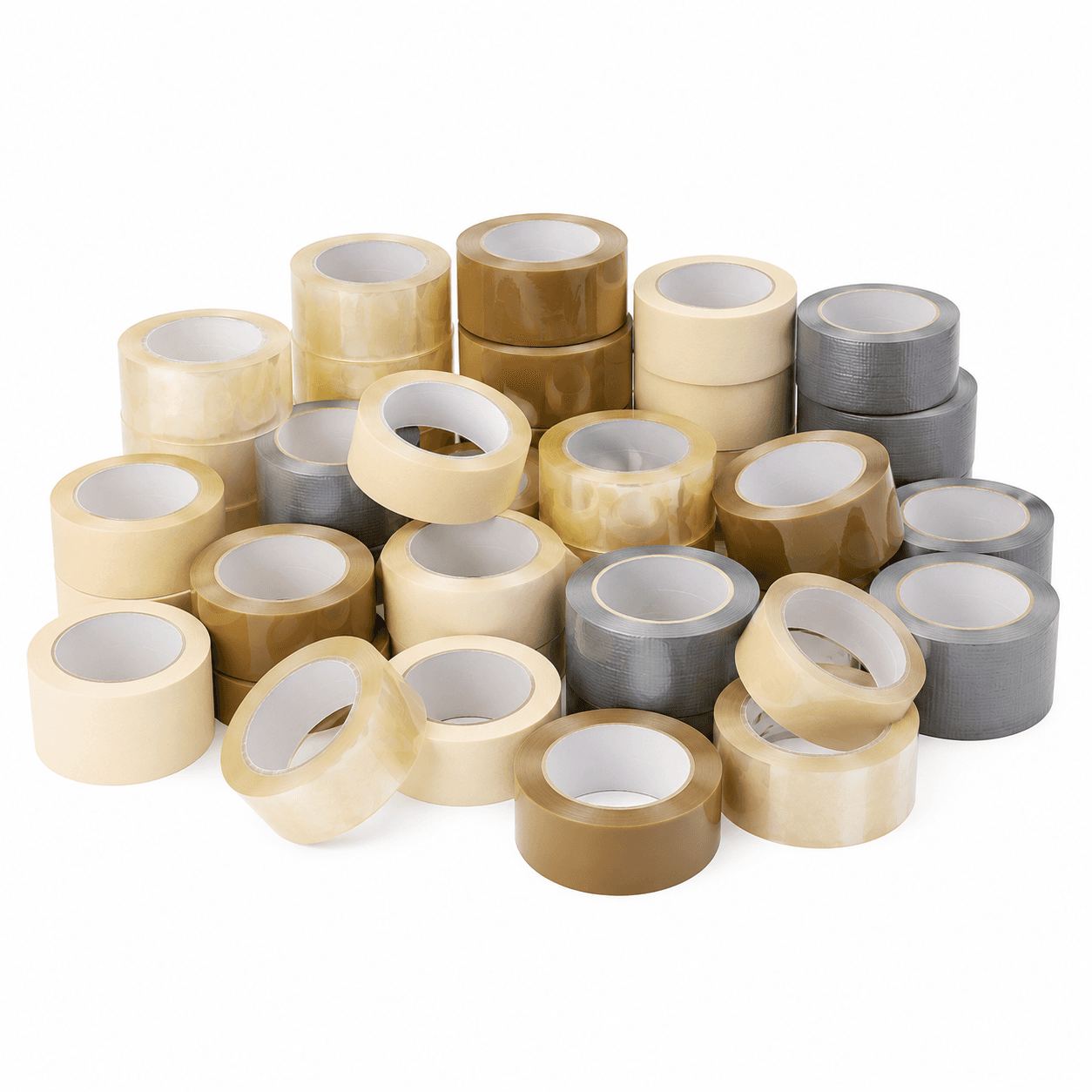
bundle of tape.
4 kinds of tape. 6 rolls each.
We sell four kinds of tape. This is all four of them. Someone put them together in a box and now you can have all of them at once.
6 rolls of each. One box. Done.
This is a good gift. This is also a good thing to buy yourself. We're not going to tell you which one you're doing. That's between you and whoever asks.
free shipping
about
The kind that lives in a junk drawer or office shelf, in an unmarked package, doing its job well without any recognition necessary. Our tape works great. Sticks instantly.™ Look, we get it. It's not glamorous, but we do it. We sell tape.
We're a microbrand that appreciates a good tape and wants to sell it for less than big tape. But that's hard. We're trying. So, yeah, it's just tape. That's the company. Please buy our tape.
everything you never knew you
wanted to know about tape.
It's totally ok if you skip this.
01
tape was invented by a banjo player.
Richard Drew dropped out of engineering school after one year. He was putting himself through college playing banjo in Twin Cities dance halls when he applied for a lab technician job at Minnesota Mining and Manufacturing — a sandpaper company — in 1921. They hired him anyway.
While delivering sandpaper samples to auto body shops, he noticed painters struggling to mask off sections of cars for two-tone paint jobs. The tape they used pulled the paint right off. Drew spent two years developing a solution.
He invented masking tape in 1925. Transparent tape in 1930. Both changed everything.
He never went back to finish the degree. Nobody asked him to.
02
tape got its name from an insult.
Drew's early masking tape had adhesive only along the edges — not in the center. A frustrated auto painter told him to go back to his “Scotch bosses and tell them to put more adhesive on it.”
”Scotch” at the time meant cheap. Miserly. Penny-pinching.
3M named the whole product line after the insult.
It worked out fine.
03
tape saved 3M during the Great Depression.
Transparent tape launched in 1930 — the first full year of the Depression. The timing looked terrible. It turned out to be perfect.
Americans used it to repair torn book pages, mend clothing, fix broken toys, seal opened food cans, and patch cracked eggs so chicks could hatch. Banks used it to repair torn currency. The product sold itself because people genuinely couldn't afford to throw anything away.
3M was one of the only major companies in America that didn't lay off a single employee during the Depression.
The tape paid for it.
04
tape doesn't use glue.
Nothing in tape works the way most people assume. There's no drying, no curing, no chemical reaction happening on your desk.
Pressure-sensitive adhesive — the kind in your tape — bonds through van der Waals forces: tiny molecular attractions between the adhesive and whatever surface you press it against. No heat. No water. No waiting. Just pressure. Your finger. Done.
The adhesive is engineered to be permanently tacky at room temperature. Strong enough to hold. Weak enough to release without destroying the surface underneath.
Getting that balance right took decades of chemistry. It feels like nothing when it works.
05
the tape dispenser was invented two years after the tape.
The snail-shaped dispenser with the serrated cutting blade didn't exist when transparent tape launched. People had to figure out how to tear it themselves, which was not obvious and usually went badly.
John Borden, a 3M engineer, invented the dispenser in 1932. The first versions were cast metal. Heavy. Serious.
The design has not fundamentally changed in 94 years.
It is one of the most quietly successful pieces of industrial design in history. Nobody talks about it. It just sits on desks.
06
tape emits x-rays.
In a vacuum.
Soviet scientists discovered in 1953 that peeling tape off a roll in a vacuum produces x-rays. The finding was documented and then largely ignored in the West for about half a century.
In 2008, researchers at UCLA confirmed it. Peeling tape rapidly in a near-perfect vacuum causes charges to build up — positive on the exposed tape, negative on the roll. The discharge accelerates electrons fast enough to produce x-ray-quality radiation when they decelerate.
The UCLA team used it to x-ray a human finger. The resolution was good enough to see the spaces between the bones.
In normal air, at normal pressure, this doesn't happen. The air absorbs the energy.
You have been completely safe this entire time.
07
you can see tape glow in the dark.
In a dark room, peel a roll of tape slowly. Look at the point where it separates from the roll.
You'll see a faint blue-white glow. This is triboluminescence — light produced by friction between surfaces. The same effect makes wintergreen mints spark when you bite them in the dark.
It is a party trick that requires no setup, costs almost nothing, and works every time.
We're not sure why we're telling you this. We think you should know.
08
the backing is a film, not a paper.
The clear part of scotch-style tape is biaxially oriented polypropylene — BOPP — a plastic film stretched in two directions during manufacturing to align its molecular structure. The stretching is what gives it tensile strength, clarity, and resistance to tearing.
The film starts as a jumbo roll roughly the width of a highway lane. It gets coated with adhesive, dried, wound back up, and slit into the narrow rolls you actually use.
The roll in your hand is a sliver of something that was briefly enormous.
The core it's wound on is cardboard. This is intentional. It collapses under pressure rather than resisting it, which protects the tape during shipping. Even the cardboard is doing something.
09
3M makes over 900 types of tape.
The transparent tape you already own is one of more than 900 distinct pressure-sensitive tape products in 3M's portfolio. Tapes that survive rocket launches. Tapes used in open-heart surgery. Tapes that conduct electricity and tapes that block it. Tapes engineered to adhere to human skin without causing damage on removal. Tapes that hold aircraft panels in place at altitude.
All of them share the same basic structure: a backing, a primer, an adhesive, a release coating so they don't stick to themselves when rolled.
The one on your desk works the same way. It is not less impressive for being simple.
10
tape holds up spacecraft.
NASA uses tape throughout space vehicle manufacturing — securing labels, protecting hardware during fabrication, providing security seals, protecting tooling surfaces. The shuttle program's solid rocket motors used reinforced teflon tape, double-face tape, and vinyl tape, each selected for its ability to hold fast, release clean, and leave no residue.
During the Apollo 13 emergency, astronauts used duct tape to build a carbon dioxide scrubber adapter from mismatched parts. It worked. They came home.
Tape is not glamorous. It is extremely reliable. These are not unrelated things.
11
the global tape market is worth $88 billion.
Every year. Larger than the global film industry. Larger than the entire recorded music business. Larger than most things people talk about more.
Polypropylene backing — the same material in your roll of tape — accounts for the single largest share of that market. Packaging is the largest application by volume.
The product that started as a fix for two-tone car paint is now infrastructure. Nobody noticed it becoming that. That's usually how infrastructure works.
12
tape got better because of a war.
During World War II, 3M diverted nearly all tape production to the military. The company developed more than 100 types of tape to solve wartime manufacturing problems — sealing, labeling, protecting parts in transit.
Rubber shortages forced a switch from rubber-based adhesives to synthetic acrylate. The acrylate wasn't as strong at first. But it aged better. Stayed clearer longer. Didn't yellow and brittle over time the way rubber did.
After the war, 3M paired the acrylate adhesive with an acetate backing and created Magic Tape — the first tape that looks frosted on the roll and invisible on paper. The one that disappears when you smooth it down.
That came from a shortage. Most good things do.
13
tape wasn't built to last forever. but it does anyway.
Properly stored — away from heat, humidity, and UV — a roll of quality acrylic adhesive tape can hold its bond for 10 years or more. Some archival tapes are rated for decades.
The thing you used to wrap a package this morning will probably still be holding that package together when the package is forgotten in a storage unit somewhere in 2035.
Tape outlasts the things it's holding together. It doesn't make a big deal about this.
14
china produces most of the world's tape.
China manufactured 1.4 million metric tons of self-adhesive plastic tape in 2024. It consumed about 966,000 tons domestically. The rest — 493,000 tons, valued at $1.8 billion — was exported. The United States, Vietnam, and Mexico are the top three destinations.
For reference: 493,000 metric tons of tape is roughly the weight of 3,300 blue whales.
China also imports tape. The tape it imports averages $25,161 per ton. The tape it exports averages $3,693 per ton. It sells cheap and buys expensive — commodity out, specialty in.
It is a sensible business model. Tape is how you can tell.
15
importing tape from china now costs about 41% extra.
A roll of tape that left a factory in Yiwu, Zhejiang and entered the United States in 2026 arrived carrying a tariff stack built from three separate layers: a 6% base import duty, a 25% Section 301 tariff imposed in 2018 and never removed, and a 10% fentanyl tariff reduced from 20% following a Trump-Xi meeting in late 2025.
Approximately 41 cents of tax on every dollar of tape. On a $0.40 roll, that's $0.16 in duties before the product has touched a warehouse, a truck, or a fulfillment center.
The tariffs were designed to pressure China on trade policy. Tape was not specifically the target. It got caught anyway. Most things did.
16
the de minimis loophole is closed.
Until recently, packages from China valued under $800 entered the United States duty-free. No customs inspection. No tariff. This is called the de minimis exemption, and it was the economic engine behind Shein, Temu, and factory-direct shipping models worldwide.
In fiscal year 2024, about 1.36 billion shipments used this exemption — more than double the number from four years prior.
In 2025, the exemption was eliminated for Chinese goods subject to Section 301 tariffs. Which includes tape. Every package now pays, regardless of value.
The era of $3 direct-from-factory tape shipped to your door, duties included, is over.
17
china's share of US imports has nearly halved since 2017.
In 2017, China supplied 22% of all US goods imports. By 2024 that number had fallen to roughly 13.8% — a drop driven almost entirely by tariffs.
American factories didn't fill the gap. Instead, imports migrated to Vietnam, Mexico, and India, each gaining roughly two percentage points of US import market share over the same period.
The research suggests this wasn't just rerouting. Companies actually moved production. Supply chains that took decades to build were rebuilt, imperfectly, under tariff pressure, in under seven years.
Tape was part of that shift. So was almost everything else.
18
the US tape manufacturing industry has grown at 0.7% annually.
For five years. Steady. Slow. Not especially exciting.
The three biggest domestic players — 3M, Intertape Polymer Group, and tesa — compete on specialty products: medical, aerospace, automotive, construction. Categories where margins are higher and Chinese imports are less relevant.
The commodity end — the tape on your desk, the tape on your packages — is largely imported. Domestic manufacturers compete where the product is technically complex.
The simple stuff comes from somewhere else. That somewhere else is currently being renegotiated. Nobody knows exactly how it ends. Tape will be involved.
faq
is this real tape?
Yes.
is it good tape?
Yes.
why does the packaging look like that?
We thought about it a lot.
what if I need more than you show?
Email us. We'll figure it out. You can bet on that.
do you ship internationally?
Not yet. Working on it. Please be patient with us.
what is the tape made of?
Depends which one. Transparent: BOPP film, acrylic adhesive, 3/4 in × 36 yd. Duct: cloth-backed, 2 in × 35 yd. Masking: crepe paper, 1 in × 30 yd. Packing: acrylic, 2 in × 55 yd. All of it sticks. That's the whole thing.
why do you have so many things with ™?
There are a lot of things you can say about tape and we wanted you to know that.
Tape is useful. We sell tape, so we believe that.